Neuro-ophthalmology questions of the week: NOI16-Nystagmus and Other Ocular Oscillations 3 – Acquired Nystagmus

Questions:
Acquired Nystagmus
9. What are the characteristics, concerns, lesion location, and treatment for gaze-evoked nystagmus?
10.  What are the characteristics, concerns, lesion location, and treatment for nystagmus with positional vertigo?
11. What are the characteristics, concerns, lesion location, and treatment for downbeat nystagmus?
12. What are the characteristics, concerns, lesion location, and treatment for upbeat nystagmus?
13. What are the characteristics, concerns, lesion location, and treatment for periodic alternating nystagmus?
14. What are the characteristics, concerns, and lesion location for rebound nystagmus?
15.  What are the characteristics and lesion location Brun nystagmus?
16. What are the characteristics, concerns, and treatment for dissociated jerk nystagmus?
17. What are the characteristics, concerns, lesion location, and treatment for acquired pendular nystagmus?
18. What are the characteristics, concerns, lesion location, and treatment for seesaw nystagmus?
19. What are the characteristics, lesion location, and treatment for oculopalatal myoclonus?
20. What are the characteristics, concerns, lesion location, and treatment for oculomasticatory myorhythmia?
21. What are the characteristics, concerns, and treatment for Wernicke encephalopathy?
22. Which patterns of jerk nystagmus have localizing/diagnostic value?
23. Which patterns of pendular nystagmus have localizing/diagnostic value?

Recommended Reading – The clinical evaluation of infantile nystagmus: What to do first and why

Recommended Reading – The clinical evaluation of infantile nystagmus: What to do first and why

The clinical evaluation of infantile nystagmus: What to do first and why.
Morgan Bertsch, Michael Floyd, Taylor Keohea, Wanda Pfeifer, and Arlene V. Dracka Ophthalmic Genet. 2017 ; 38(1): 22–33.
Department of Ophthalmology, Roy J. and Lucille A. Carver College of Medicine, University of Iowa, Iowa City, Iowa, USA

Abstract Introduction—Infantile nystagmus has many causes, some life threating. We determined the most common diagnoses in order to develop a testing algorithm.

Methods—Retrospective chart review. Exclusion criteria were no nystagmus, acquired after 6 months, or lack of examination. Data collected: pediatric eye examination findings, ancillary testing, order of testing, referral, and final diagnoses. Final diagnosis was defined as meeting published clinical criteria and/or confirmed by diagnostic testing. Patients with a diagnosis not meeting the definition were “unknown.” Patients with incomplete testing were “incomplete.” Patients with multiple plausible etiologies were “multifactorial.” Patients with negative complete workup were “motor.”

Results—284 charts were identified; 202 met inclusion criteria. The 3 most common causes were Albinism(19%), Leber Congenital Amaurosis(LCA)(14%) and Non-LCA retinal dystrophy (13%). Anatomic retinal disorders comprised 10%, motor another 10%. The most common first test was MRI (74/202) with a diagnostic yield of 16%. For 28 MRI-first patients, nystagmus alone was the indication; for 46 MRI-first patients other neurologic signs were present. 0/28 nystagmus-only patients had a diagnostic MRI while 14/46 (30%) with neurologic signs did. Yield of ERG as first test was 56%, OCT 55%, and molecular genetic testing 47%. 90% of patients had an etiology identified.

Conclusion—The most common causes of infantile nystagmus were retinal disorders (56%), however, the most common first test was brain MRI. For patients without other neurologic stigmata complete pediatric eye examination, ERG, OCT and molecular genetic testing had a higher yield than MRI scan. If MRI is not diagnostic, a complete ophthalmologic workup should be pursued.

Full Article https://drive.google.com/open?id=1h76ziIrxB6TpINMsPF1mcsWvvAvVkaj3


NOI16-Nystagmus and Other Ocular Oscillations 2 – Infantile Nystagmus

Questions:
Infantile (congenital) Nystagmus
5. What are the characteristics, associated conditions, concerns, and treatment for infantile nystagmus?

Other Types of Infantile Nystagmus
6. What are the characteristics and associated conditions for latent nystagmus?
7. What are the characteristics, associated conditions, concerns, lesion location and treatment for spasmus nutans?
8. What are the characteristics, and lesion location for infantile monocular pendular nystagmus?

https://lh4.googleusercontent.com/Gt4dXacAnmGJwfgR9EIJQVdqsG39U_FLEbrM7T1e_YCH8Raza2n7WAW4vHFELSC4gsZ2sCgoBYrlcftn1TA4jji2un1nBpYJzznscv4y6lnJvxBvuKPRD8WBV_2y4u3GDM4hvSmj

Recommended Reading – Mystery Case: A young woman with isolated upbeating nystagmus.

Recommended Reading – Mystery Case: A young woman with isolated upbeating nystagmus.
Charlene Ong, Kevin Patel, Erik Musiek, Gregory Van Stavern.
Neurology 2015; 84 (4) RESIDENT AND FELLOW SECTION
http://n.neurology.org/content/84/4/e17.full

ARTICLE
A 15-week pregnant 21-year-old woman initially presented with nausea, vomiting, and abdominal pain. The patient admitted to decreased oral intake over the past 4 weeks, including her prescribed prenatal vitamins. She was hypokalemic with elevated transaminases and gallstone pancreatitis was confirmed by imaging. Prior to cholecystectomy, fetal heart tones were lost and intrauterine fetal demise occurred. The patient underwent dilation and evacuation as well as cholecystectomy. She was discharged home but returned within 1 week with persistent nausea and vomiting. She had no neurologic complaints at the time. Basic metabolic panel on admission was unremarkable. On hospital day 2, she developed oscillopsia. Her examination was remarkable for large amplitude upbeating nystagmus (UBN) in primary position. She had gaze-evoked UBN in all other directions. The amplitude of the UBN increased on upgaze and dampened on downgaze. Smooth pursuit was impaired in all directions and saccades were dysmetric (video https://www.youtube.com/watch?v=b8j3LcwY2ZM).

Extraocular movements were intact with no evidence of ophthalmoplegia. Pupils were equal and reactive, and fundus examination was normal. Reflexes were present and symmetric, and gait was normal. The patient had no deficits on mental status examination. She was oriented to name, date, place, and situation and had no difficulty with complex commands, calculations, or short-term or long-term memory. Language was similarly intact. She demonstrated no ataxia or other focal abnormalities on examination.

Questions for consideration:
1. What is the differential diagnosis with this history and examination?
2. What is the next step in management for this patient? What tests would you order?

Neuro-ophthalmology questions of the week: NOI16-Nystagmus and Other Ocular Oscillations 1 – Basics

Questions:
Nystagmus Basics
1. What 14 features should be assessed in the evaluation of a patient with nystagmus?
2. What are the characteristics of physiologic nystagmus?
3. What are the characteristics, lesion locations, associated conditions, concerns, and treatment for peripheral vestibular nystagmus?
4. What are the characteristics, lesion locations, associated conditions, and concerns for central nystagmus?

Recommended Reading – IMAGES IN CLINICAL MEDICINE Orbital Varix

Recommended Reading – IMAGES IN CLINICAL MEDICINE Orbital Varix
Kiang L, Kahana A. N Engl J Med 2015; 372:e9v

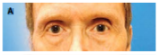
A 63-year-old man was referred to our clinic with a 13-year history of intermittent vision loss, binocular diplopia, and blepharoptosis of the left eye during bending or straining that had worsened over the previous year. Other than uneventful cataract surgery, the patient had no clinically significant ocular history, and prior computed tomographic (CT) scans of the head and orbit did not identify any abnormality. An orbital vascular anomaly was suspected. A CT scan of the head was obtained while the patient performed the Valsalva maneuver, revealing the expansile orbital mass. On presentation to us, the patient’s visual acuity was 20/20 in the right eye and 20/50 in the left eye, with a relative afferent pupillary defect in the left eye. There was no proptosis on examination (Panel A).

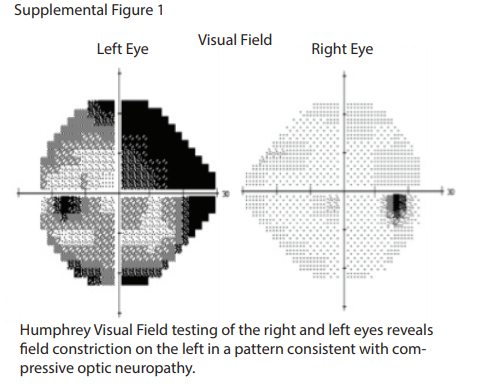
Visual-field testing revealed severe constriction.

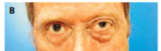
A Valsalva maneuver induced 6 mm of proptosis in the left eye, with anterior superior globe displacement and blepharoptosis (Panel B, and video).

   Orbital Varix. (00:19)

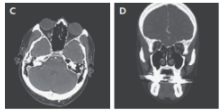
Proptosis quickly reversed on relaxation. CT of the orbit while the patient waw at at rest was unremarkable (Panels C and D show the axial and coronal views, respectively),

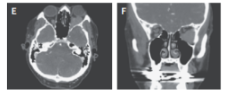
but a Valsalva maneuver revealed an orbital mass causing anterior superior globe displacement (Panels E and F).

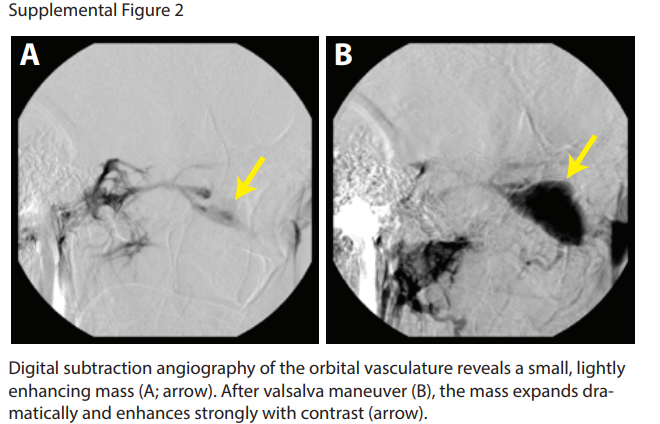
An orbital angiogram confirmed the presence of an expansile orbital mass (Fig. 2 in the Supplementary Appendix).

Although the differential diagnosis of an orbital mass is broad and includes lymphoma, metastatic tumors, and inflammatory masses, the clinical findings and imaging studies in this patient were pathognomonic of an orbital vascular anomaly and were most consistent with a distensible venous anomaly (i.e., varix). In the confines of the orbit, an expansile mass can cause intermittent orbital compartment syndrome and compressive optic neuropathy. The patient underwent successful endovascular and transorbital sclerosing treatment. The postoperative visual acuity was 20/30 in the left eye, with a stable visual field.


Neuro-ophthalmology questions of the week: NOI15-Cavernous Sinus and Orbital Vascular Disorders 4

Questions:
18. What is the cause of “orbital varices”?
19. What should be considered when a crying infant eye bulges?

Recommended Reading Cavernous Sinus Thrombosis

From:  MRI in the Evaluation of Acute Visual Syndromes.
Mukhi SV, Lincoln CM. Topics in Magnetic Resonance Imaging 24 (6):309-24. 2015
https://drive.google.com/open?id=1ayqCxDRn0E_Own4NkKoWbC2zqvfAc2X8

The prevalent use of antibiotics has decreased the overall incidence of CST. CST still carries significant mortality, commonly reported as approximately 30%, with more than 50% of the cases resulting in morbidity secondary to cranial neuropathies. CST is subclassified as aseptic or infectious in etiology. Aseptic causes include surgery or trauma. Infectious CST is typically a complication of a facial, orbital, odontogenic, or paranasal sinus infection. Sinusitis is the most common cause of CST, whereas odontogenic sources have been reported in up to 10% of the cases.3,33–39

The CS is a paired structure on either side of the sella, pituitary gland, and sphenoid sinus. It is composed of two layers of dura that are split to create a septate venous channel. The internal carotid artery (ICA) is the most medial structure and cranial nerves III, IV, and first and second branches of cranial nerve V are located in the lateral wall of the dura. Cranial nerve VI courses at the medial aspect of the ICA. Anteriorly, the CS is bordered by the SOF and OA. The posterior margin of the CS is immediately lateral to the dorsum sella and bordered by Meckel cave medially and the petrous apex posteroinferiorly.33,40,41

CST most commonly occurs secondary to the spread of infection by emissary veins as well as by direct extension. Emissary veins throughout the skull base are valve less and have bidirectional flow, accounting for the ease of contiguous spread.41 Spread of infection also occurs by the propagation of thrombus and/or septic embolism. It is postulated that bacteria stimulate the formation of thrombus by the release of a procoagulant substance and through toxins that cause tissue damage.38 In otitis media, infection spreads via the sigmoid sinus and along the internal carotid artery plexus. Staphylococcus aureus (70%) and Streptococcus sp (22%) are the important organisms responsible for infection of the CS. In patients with uncontrolled diabetes and immunocompromise, fungal infection can also be responsible, particularly mucormycosis.38,41

Tuberculosis has also been reported to cause both unilateral and bilateral CST; cavernous sinus tuberculoma may occur in the absence of pulmonary findings. Lymphomatous infiltration of the CS has been reported in both pediatric and adult patients.4

CST typically presents with orbital swelling, proptosis, chemosis, fever, and ophthalmoplegia. Visual impairment in CST has been reported in 7% to 22% of the cases, with blindness reported in 8% to 15% of the cases. As the disease progresses, decreased light perception and visual loss ensue. In a case report by Chen et al, CST-induced blindness suggested involvement of the bilateral retina and optic nerves. The postulated mechanisms accounting for visual impairment and blindness in CST include venous infarction of the retina and retinal ischemia caused by occlusion of either an ophthalmic artery branch or the central retinal artery, or by mechanical pressure at the OA.39

Chemosis, periorbital edema, and proptosis have been attributed to venous congestion.38 Papilledema as a result of raised intracranial pressure from a CST has been described as well.42 Palsies of III, IV, and VI cranial nerves secondary to compression result in impaired EOM motility. Intracranial extension of infection may result in meningitis, encephalitis, brain abscess, pituitary infection, epidural and subdural empyema, and coma/death.33,38,42

MRI is the radiologic examination of choice, and the CS should be imaged in its entirety. MRI demonstrates the contents of the CSs more effectively compared with CT.40 Imaging protocols should extend from the OA to the prepontine cistern. Routine T2, fluid-attenuated inversion recovery, and pre- and post-contrast T1 weighted images of the entire brain should be included. Postcontrast T1 weighted, 3-mm thick images should be obtained in the axial and coronal planes with at least one plane imaged utilizing a fat-saturation technique. Thin-section, postcontrast axial images may be acquired by three-dimensional spoiled gradient techniques. In addition, thin-section, three-dimensional, heavily T2 weighted images allow visualization of individual cranial nerves in the CS and adjacent cisterns.43 Pula et al describe the use of three-dimensional constructive interference in steady state to show smaller structures within the CS, making it the ideal choice to study cranial neuropathies in the CS.44

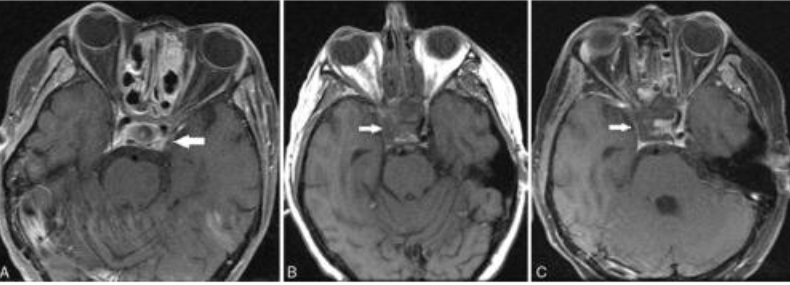
Alterations in signal intensity, size, and contour of the CS are subtle signs of thrombosis. A filling defect with enhancement of the peripheral margins of the CS suggests a clot within it (Fig. 4). Subacute thrombus exhibits high signal intensity on all pulse sequences, whereas acute thrombosis may appear more isointense. Indirect signs that may suggest the diagnosis are dilation of the superior ophthalmic veins, exophthalmos, and increased dural enhancement along the lateral border of CS and ipsilateral tentorium. Appropriate clinical symptoms, adjacent sinusitis, and orbital or odontogenic infection confirm the diagnosis and etiology.33,38,41,43

FIGURE 4. (A) Twenty-year-old man with invasive fungal sinusitis in setting of relapsed acute lymphocytic leukemia. Axial postcontrast image of the orbit and CS demonstrates filling defect in the left CS (arrow).
(B and C) Twenty-three-year old man with leukemia and rapidly progressive right-sided cranial neuropathy involving III, IV, and VI. Axial pre- (B) and post (C) contrast T1 images shows filling defect in the right CS with absence of the right cavernous carotid artery flow void (arrows).

CST therapy relies on mobilization of the varied disciplines of neurology, neurosurgery, otolaryngology, and infectious disease. Aggressive antibiotic therapy and surgical debridement of the primary site of infection and surrounding areas of involvement are the mainstay of treatment. The use of steroid therapy to reduce orbital edema and cranial nerve inflammation is controversial. Anticoagulant therapy has shown some benefit when initiated early.33,38,43

Neuro-ophthalmology questions of the week: NOI15-Cavernous Sinus and Orbital Vascular Disorders 3

Questions:
12. What are the findings of thrombosis of the cavernous sinus?
13. What is the usual cause of cavernous sinus thrombosis?
14. What should be considered in a patient with apparent orbital cellulitis?
15. What are the major risks of thrombosis of the cavernous sinus?
16. What are 3 very serious complications of cavernous sinus thrombosis?
17. What is the mnemonic for the structures and their position in the cavernous sinus?

Recommended Reading – Neuroimaging: Carotid Cavernous Fistula CT Angiogram Findings

CTisus  Published on Feb 10, 2017

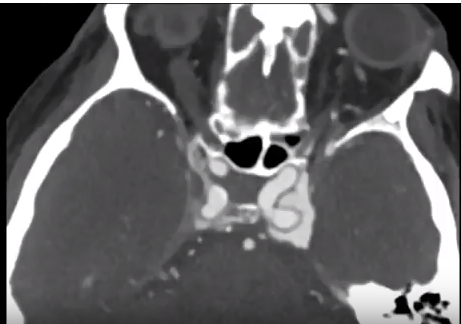
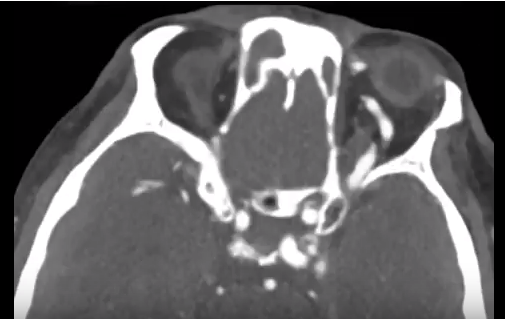
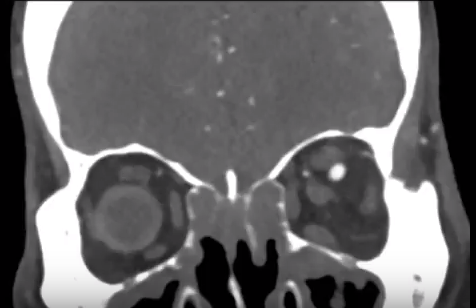
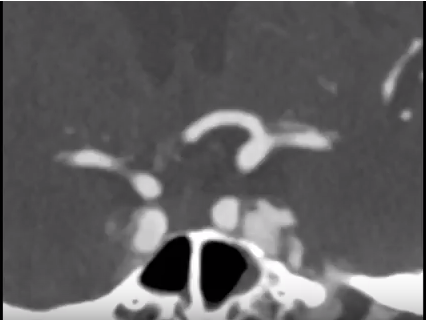
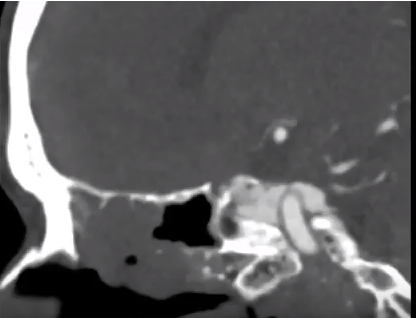
These first five CTA images of the head demonstrate filling of the left cavernous sinus in the arterial phase and asymmetric enlargement and filling of the left superior ophthalmic vein.  These findings are consistent with a carotid cavernous fistula. The diagnostic angiogram was performed to evaluate the supply and drainage of the fistula. No aneurysm was identified. The fistula was supplied most prominently from the bilateral external carotid arteries and showed prominent retrograde drainage into the dilated left superior ophthalmic vein. These fistulas may present with unilateral or bilateral proptosis and chemosis and if severe may cause vision loss. This patient was treated with transvenous coil embolization and demonstrated no evidence of fistula on two month follow-up imaging.

Video https://www.youtube.com/watch?v=gkhd36dssqA

Reference
CT is us is created and maintained by The Advanced Medical Imaging Laboratory (AMIL). AMIL is a multidisciplinary team dedicated to research, education, and the advancement of patient care using medical imaging with a focus on spiral CT and 3D imaging. The AMIL is headed by Elliot K. Fishman, M.D.

http://www.ctisus.com