Neuro-ophthalmology questions of the week: NOI15-Cavernous Sinus and Orbital Vascular Disorders 2

Questions:
6. What are 10 ocular findings of carotid cavernous fistula?
7. Which of the cranial nerves is most commonly affected by a carotid cavernous fistula?
8. Can mechanical restriction of extraocular muscles occur in carotid cavernous fistula?
9. What diagnosis should be considered in an elderly woman with a mild headache, and elevated intraocular pressure?
10. What should be considered in all patients a bruit accompanying a chronically red eye?
11. When is treatment indicated for carotid cavernous fistulas?

_____________________________________

Neuro-ophthalmology questions of the week: NOI15-Cavernous Sinus and Orbital Vascular Disorders 1

Questions:
1. What signs and symptoms may develop from an aneurysm of the internal carotid artery within the cavernous sinus?
2. What are the characteristics of direct shunts between the internal carotid artery and the cavernous sinus?
3. What are the characteristics of indirect carotid cavernous or dural shunts?
4. Does a carotid cavernous fistula have unilateral or bilateral ocular symptoms?
5. Do carotid cavernous fistulas always have ocular symptoms?

Recommended Reading – Teaching NeuroImages: Ocular bruit in carotid-cavernous sinus fistula

Teaching NeuroImages: Ocular bruit in carotid-cavernous sinus fistula
Jeong-Yoon Choi, Seol-Hee Baek, Jin-Man Jung, Do-Young Kwon,
Moon Ho Park
Neurology. August 12, 2014; 83 (7) RESIDENT AND FELLOW SECTION

ARTICLE
A 57-year-old man who had a traffic accident 1 month previously presented with left ocular pain, double vision, and left eye proptosis with ptosis and conjunctival hemorrhage. Fundus showed dilated veins with no hemorrhages or disc edema. Left ocular motility showed complete external ophthalmoplegia (figure 1). There was prominent ocular bruit in his left eye (audio file on the Neurology® Web site at Neurology.org). MRI and magnetic resonance angiography showed a dilated left superior ophthalmic vein and an extravasation into cavernous sinus (figure 2). With chemosis, ophthalmoplegia, and retro-orbital pain, the auscultation of orbital bruit can make a correct and prompt diagnosis in the patient with carotid-cavernous sinus fistula.1


Figure 1 Physical examination
(A) Left eye with conjunctival injection and ptosis.

(B) Left eye proptosis.
(C) Fundus shows dilated veins with no hemorrhages or disc edema.
(D) Ocular motility shows complete external ophthalmoplegia in left eye and partial limitation of abduction in right eye.


Figure 2 Brain MRI and magnetic resonance angiography findings
(A) magnetic resonance angiography
(B) show a dilated left superior ophthalmic vein (black arrowhead) and a extravasation into cavernous sinus (white arrow).

Audio. Auscultation of ocular bruit.

(audio.mp3)
It was recorded using the JABES electronic stethoscope (GS tech., Korea) and WavePad Sound Editor (NCH software, Australia).

AUTHOR CONTRIBUTIONS Dr. Choi: participated in conceptualization of the manuscript, drafted the manuscript. Dr. Baek: participated in analysis of results and conceptualization of the manuscript. Dr. Jung: selected appropriate images and revised the manuscript for intellectual content. Dr. Kwon: participated in analysis of results and revised the manuscript for intellectual content. Dr. Park: drafted the manuscript and figure legend and revised the manuscript for intellectual content.

STUDY FUNDING
 
No targeted funding reported.
DISCLOSURE The authors report no disclosures relevant to the manuscript. Go to Neurology.org for full disclosures.
Footnotes
Go to Neurology.org for full disclosures. Funding information and disclosures deemed relevant by the authors, if any, are provided at the end of the article.
Supplemental data at Neurology.org
Download teaching slides: Neurology.org
© 2014 American Academy of Neurology

REFERENCE 1. Ling JD, Chao D, Al Zubidi N, Lee AG. Big red flags in neuro-ophthalmology. Can J Ophthalmol2013;48:3–7.


Neuro-ophthalmology questions of the week: NOI14 Orbital Syndrome

Questions:
1. What is the orbital syndrome?
2. What are the common features of the orbital syndrome?
3. What is the most common cause of unilateral or bilateral proptosis?
4. What should be suspected if there is globe displacement with proptosis?
5. Do brain CT and MRI often miss orbital processes?

Teaching NeuroImages: The half-split man

Teaching NeuroImages: The half-split man
Makoto Takahashi, Akiko Shinya, Hisao Kitazono, Teruhiko Sekiguchi, Akira Inaba, Satoshi Orimo. Neurology. September 13, 2016; 87 (11) RESIDENT AND FELLOW SECTION

ARTICLE
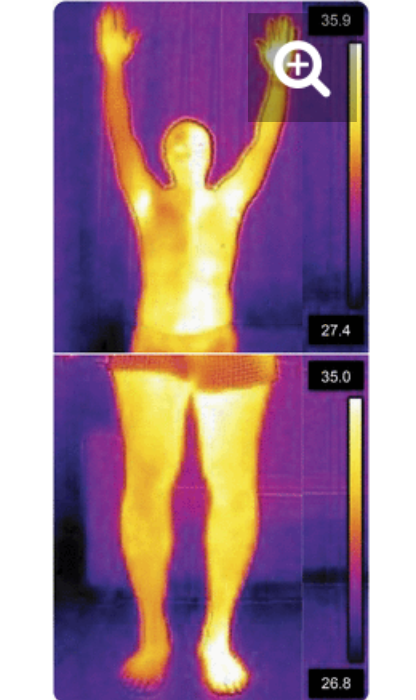
A 51-year-old man was admitted with left lateral medullary infarction due to vertebral artery dissection (figure 1). Neurologic examination revealed nystagmus, dissociated sensory disturbance, and no evidence of paralysis. Miosis and ptosis were observed on the ipsilateral side, but hypohidrosis was not apparent. Thermography revealed a bilateral discrepancy in body temperature, as if the patient were split down the middle (figure 2). Asymmetric skin temperature can occur among patients with Wallenberg syndrome associated with Horner syndrome due to a disturbance of the descending sympathetic tract that causes ipsilateral hypohidrosis and increased cutaneous blood flow.1

Figure 1 MRI and magnetic resonance angiography of the medulla and the vertebral artery
Diffusion-weighted and T2-weighted images show an acute infarction of the left lateral medulla (A, B). Magnetic resonance angiography and black-blood MRI show dissection of the left vertebral artery (C, D).

Figure 2 Thermography findings
Thermography images show the bilateral discrepancy in body temperature (in °C), as though the patient were split down the middle of his body.

AUTHOR CONTRIBUTIONS Dr. Takahashi: study concept, interpretation of data, and drafting the manuscript. Dr. Shinya: revision of the manuscript for intellectual content. Dr. Sekiguchi: study supervision. Dr. Kitazono: study supervision. Dr. Inaba: study supervision. Dr. Orimo: revision of the manuscript for intellectual content and study supervision.

STUDY FUNDING No targeted funding reported.

DISCLOSURE The authors report no disclosures relevant to the manuscript. Go to Neurology.org for full disclosures.

Footnotes Download teaching slides: Neurology.org

REFERENCE
1. Korpelainen JT, Sotaniemi KA, Myllylä VV. Asymmetrical skin temperature in ischemic stroke. Stroke 1995;26:1543–1547.


Neuro-ophthalmology Questions of the Week: NOI13 Diplopia10.3 – Other Eye Movement Abnormalities

Questions:
21. What is the Raymond syndrome?
22. What is the Millard-Gubler syndrome?
23. What is the Foville syndrome?
24. What is the Wallenberg syndrome?
25. What is the Weber syndrome?
26. What is the Nothnagel syndrome?
27. What is Benedikt syndrome?
28. What is the Claude syndrome?
29. What is the top of the basilar syndrome?
30. What systemic disorders can affect the ocular motor cranial nerves?

Teaching Video NeuroImages: Is it III alone, or III and IV?

Teaching Video NeuroImages: Is it III alone, or III and IV?
Stephen G. Reich

Neurology May 22, 2007; 68 (21)
RESIDENT AND FELLOW SECTION http://n.neurology.org/content/68/21/E34

Series editor: Mitchell S.V. Elkind MD, MS, Section Editor

The most important questions, when confronted with an oculomotor (III) palsy are:  
1) Is the pupil spared?
2) Is it complete aside from pupil sparing? and
3) Is it in isolation?

A “no” answer to any makes a benign, ischemic III palsy less likely.1

In the presence of a III palsy, the traditional method of testing the trochlear nerve (IV) at the bedside by asking the patient to depress the adducted eye cannot be performed. Instead, the patient should be instructed to abduct the eye and then look down; if IV is intact, there will be intorsion.2

Confirming that IV is intact in the presence of a III palsy is important because the combination of an oculomotor and trochlear palsy suggests a lesion in the cavernous sinus.

A 56-year-old man presented with a complete, pupil-sparing right oculomotor palsy (video E-1). The evaluation was negative, and the palsy resolved within 1 month.
Video
The video demonstrates a pupil-sparing but otherwise complete right oculomotor palsy.
There is ptosis. The eye is down, out, and unable to adduct, depress, or elevate. With attempted down gaze, there is intorsion, confirming that IV is intact. Although not demonstrated in the video, this primary action of IV should be tested by first having the patient abduct and then attempt to depress the eye. Intorsion is best appreciated by observing a medial conjunctival vessel.

ACKNOWLEDGMENT The author thanks Dr. Neil Miller for assistance.

Footnotes Disclosure: The author reports no conflicts of interest.

REFERENCES
1. Trobe JD. Isolated third nerve palsies. Sem Neurol 1986;6:135–141.
2. Ansons AM, Davis H. Diagnosis and management of ocular motility disorders. 3rd ed. Oxford: Blackwell Science Ltd, 2001:359–360.


Neuro-ophthalmology Questions of the Week: NOI13 Diplopia10.2 – Other Eye Movement Abnormalities

Questions:
11. What is the Tolosa-Hunt syndrome?
12. Where do these findings localize the lesion: Nystagmus, skew deviation, ocular tilt reaction, vertigo, lateropulsion, ipsilateral Horner syndrome, cerebellar syndrome, facial hypoesthesia, cranial nerves IX and X, and contralateral pain and thermal hypoesthesia (Wallenberg syndrome)?
13. Where do these findings localize the lesion: 4th nerve palsy with contralateral Horner syndrome?
14. Where do these findings localize the lesion: 3rd nerve palsy with contralateral ptosis and contralateral superior rectus weakness?
15. Where do these findings localize the lesion: 3rd nerve palsy with contralateral hemiparesis (Weber syndrome)?
16. Where do these findings localize the lesion: 3rd nerve palsy and ipsilateral cerebellar ataxia (Nothnagel syndrome)?
17. Where do these findings localize the lesion: 3rd nerve palsy and contralateral tremor (Benedikt syndrome)?
18. Where do these findings localize the lesion: 3rd nerve palsy and contralateral ataxia with tremor (Claude syndrome)?
19. Where do these findings localize the lesion: 3rd nerve palsy with vertical gaze palsy, lid retraction, skew deviation, and convergence nystagmus?
20. Where do these findings localize the lesion: 3rd nerve palsy with depressed mental status?  

Pearls and oy-sters of localization in ophthalmoparesis

Pearls and oy-sters of localization in ophthalmoparesis
Teresa Buracchio, Janet C. Rucker
Neurology. December 11, 2007; 69 (24) RESIDENT AND FELLOW SECTION

Abstract
Ocular misalignment and ophthalmoparesis result in the symptom of binocular diplopia. In the evaluation of diplopia, localization of the ocular motility disorder is the main objective. This requires a systematic approach and knowledge of the ocular motor pathways and actions of the extraocular muscles. This article reviews the components of the ocular motor pathway and presents helpful tools for localization and common sources of error in the assessment of ophthalmoparesis.

Neuro-ophthalmology Questions of the Week: NOI13 Diplopia10.1 – Other Eye Movement Abnormalities

Questions:
1. What are the findings of the Locked-in Syndrome?
2. Where is the lesion in the Locked-in Syndrome?
3. What is Ocular Neuromyotonia?
4. What are the symptoms of Ocular Neuromyotonia?
5. What is the usual cause of Ocular Neuromyotonia?
6. Where do these findings localize the lesion: Horizontal gaze palsy with ipsilateral facial palsy?
7. Where do these findings localize the lesion: 6th nerve palsy with contralateral hemiparesis (Raymond syndrome)?
8. Where do these findings localize the lesion: 6th nerve palsy with ipsilateral seventh nerve palsy and contralateral hemiparesis (Millard-Gubler syndrome)?
9. Where do these findings localize the lesion: 6th nerve palsy with ipsilateral seventh nerve palsy, deafness, hypoesthesia, Horner syndrome, contralateral pain and thermal hypoesthesia, ataxia (Foville syndrome)?
10. Where do these findings localize the lesion: 6th nerve palsy with ipsilateral Horner Syndrome?