Recommended Reading – Trigeminal neuralgia

Trigeminal neuralgia
Leclercq D, Thiebaut JB, Héran F.
Diagn Interv Imaging. 2013 Oct;94(10):993-1001.  

Abstract
Two different clinical entities, essential or secondary neuralgia, are associated with different pathologies. The pathways of CN V comprise the cervical spine, the brainstem, the root of the nerve and the three peripheral branches: V1, V2, and V3. The lesions responsible for neuralgia are neoplastic, vascular, inflammatory, malformative or post-traumatic. The examination protocol should explore the set of CN V pathways. Neurovascular compression is the main cause of essential neuralgia. It is investigated by T2-weighted inframillimeteric volume. Two conditions are necessary to diagnose a neurovascular compression: localized on the root entry zone [(REZ), 2-6mm from the emergence of the pons] and perpendicularly. In the absence of neurovascular compression, thin slices and a gadolinium injection are necessary.

TAKE-HOME MESSAGES
• The range of pathologies responsible for trigeminal neuralgia is vast: neoplastic, vascular, inflammatory, malformative or post-traumatic.
• Two different clinical entities: essential or secondary neuralgia are associated with different pathologies.
• The possible topographical area affected is extensive from the cervical spine to the facial region.
• MRI investigation is based on an initial imaging protocol that can be completed by examination if lesions are detected.
• In this context, clinical understanding of the patient prior to the MRI scan is often a precious aid in directing the examination (essential or secondary neuralgia, affected dermatomes).
• In the case of essential neuralgia, the most commonly observed lesion is neurovascular compression. Diagnosis is based on T2  inframillimetric acquisition by visualising a vessel perpendicular to the REZ (at 2—6 mm from the emergence of the brainstem). 3D TOF then makes it possible to determine the arterial or venous origin of the compression.
• In the case of secondary neuralgia, good understanding of the anatomy of the CN V pathways is necessary.

Figure 11. Left neurovascular compression (arrow). Perpendicular vessel leading to pressure on the nerve on the zone corresponding to REZ (2 mm from the emergence of the brainstem).

Free Full Text https://linkinghub.elsevier.com/retrieve/pii/S2211-5684(13)00245-3
 

Neuro-ophthalmology questions of the week: NOI19 -Diagnosis of Headache and Facial Pain

Questions:
1. What 3 types of symptoms can a typical migraine aura have?

2. What is the longest duration of a typical migraine aura?

3. Does a typical migraine aura develop gradually?

4. Characterize the most common type of typical migraine aura?

5. At what point in a migraine with aura attack should vasoconstrictive treatments used to abort the attack be administered (e.g. ergotamine and triptans)?

6. What are the 2 categories of trigeminal neuralgia (tic douloureux)?

7. What differentiates classic from symptomatic trigeminal neuralgia?

8. Name several triggers for trigeminal neuralgia?

9. For Classic Trigeminal Neuralgia, what are the:
     1. Age range
     2. Gender ratio
     3. Location of pain
     4. Type of pain
     5. Duration of pain
     6. Temporal pain profile
     7. Associated signs
     8. Interictal exam
     9. Treatment?

10. For Symptomatic Trigeminal Neuralgia, what are the:
     1. Age range
     2. Gender ratio
     3. Location of pain
     4. Type of pain
     5. Duration of pain
     6. Temporal pain profile
     7. Associated signs
     8. Interictal exam
     9. Treatment?

11. For Cluster (Histamine) Headache, what are the:
     1. Age range
     2. Gender ratio
     3. Location of pain
     4. Type of pain
     5. Duration of pain
     6. Temporal pain profile
     7. Associated signs
     8. Interictal exam
     9. Treatment?

12. For Episodic or Chronic Paroxysmal Hemicrania, what are the:
     1. Age range
     2. Gender ratio
     3. Location of pain
     4. Type of pain
     5. Duration of pain
     6. Temporal pain profile
     7. Associated signs
     8. Interictal exam
     9. Treatment?

13. For SUNCT Syndrome (Short-lasting, Unilateral, Neuralgiform headache attacks with Conjunctival injection and Tearing), what are the:
     1. Age range
     2. Gender ratio
     3. Location of pain
     4. Type of pain
     5. Duration of pain
     6. Temporal pain profile
     7. Associated signs
     8. Interictal exam
     9. Treatment?

14. For Hemicrania Continua, what are the:
     1. Age range
     2. Gender ratio
     3. Location of pain
     4. Type of pain
     5. Duration of pain
     6. Temporal pain profile
     7. Associated signs
     8. Interictal exam
     9. Treatment?

15. What should be measured in all patients with headache?

16. What must be ruled-out in all patients with headache?

17. What must be measured in all patients with recurrent, unilateral pain localized around the eye?

18. What lab tests should be done in all patients over age 50 with any headache or facial pain?

19. What should be considered and done when a patient presents with a thunderclap headache?

Recommended Reading – Abnormal Facial & Ocular Movement Videos

Recommended Reading – Abnormal Facial & Ocular Movement Videos

Short videos of abnormal facial and ocular movement seen in Dr. C.N. Chua’s clinic.

Ophthalmology Videos page 1 http://www.mrcophth.com/vidoes.html

Ophthalmology Videos page 2 http://www.mrcophth.com/videos2.html

From: Success in MRCOphth by Dr. C.N. Chua http://www.mrcophth.com/chua1.html

Neuro-ophthalmology questions of the week: NOI17-Disorders of the Eyelid 2

Questions:
16. What is apraxia of eyelid opening?
17. What is thought to cause apraxia of eyelid opening?
18. Apraxia of eyelid is associated with what 4 conditions?
19. What should be ruled out in all cases of ptosis?
20. What are 8 causes of pseudoptosis?
21. What does a show of sclera between the upper eyelid and limbus suggest?
22. What are the 3 categories of eyelid retraction?
23. What are the 3 most common causes of lid retraction?
24. What are 5 causes of mechanical lid retraction?
25. What are 2 causes of myogenic lid retraction?
26. What are 6 causes of neurogenic lid retraction?
27. What may patients with a peripheral facial palsy ultimately develop?
28. What should be suspected in all patients with hemifacial spasm?
29. What test should be done in all patients with hemifacial spasm?
30. What are 4 causes of blepharospasm?
31. A patient has blepharospasm accompanied by dystonic movements of the lower face or neck. What is the diagnosis?
32. Is eyelid pain to be expected in a patient with blepharospasm?
33. How is a patient with blepharospasm likely to describe their eyelid pain?
34. What is the treatment of choice in patients with chronic blepharospasm?
35. What is the treatment of choice in patients with hemifacial spasm?
36. What is the mechanism of action of botulinum toxin injections?
37. Does botulinum toxin injection relieve the crampy pain of a patient with blepharospasm?

Recommended Reading – 1. A ripping roller coaster ride & 2. Stroke

Recommended Reading – 1. A ripping roller coaster ride & 2. Stroke Due To Extracranial Internal Carotid Artery Dissection After Roller Coaster Rides In A 4-Year-Old Boy

A ripping roller coaster ride
David J. Blacker, Eelco F.M. Wijdicks
Neurology. 2003
NEUROIMAGES

ARTICLE
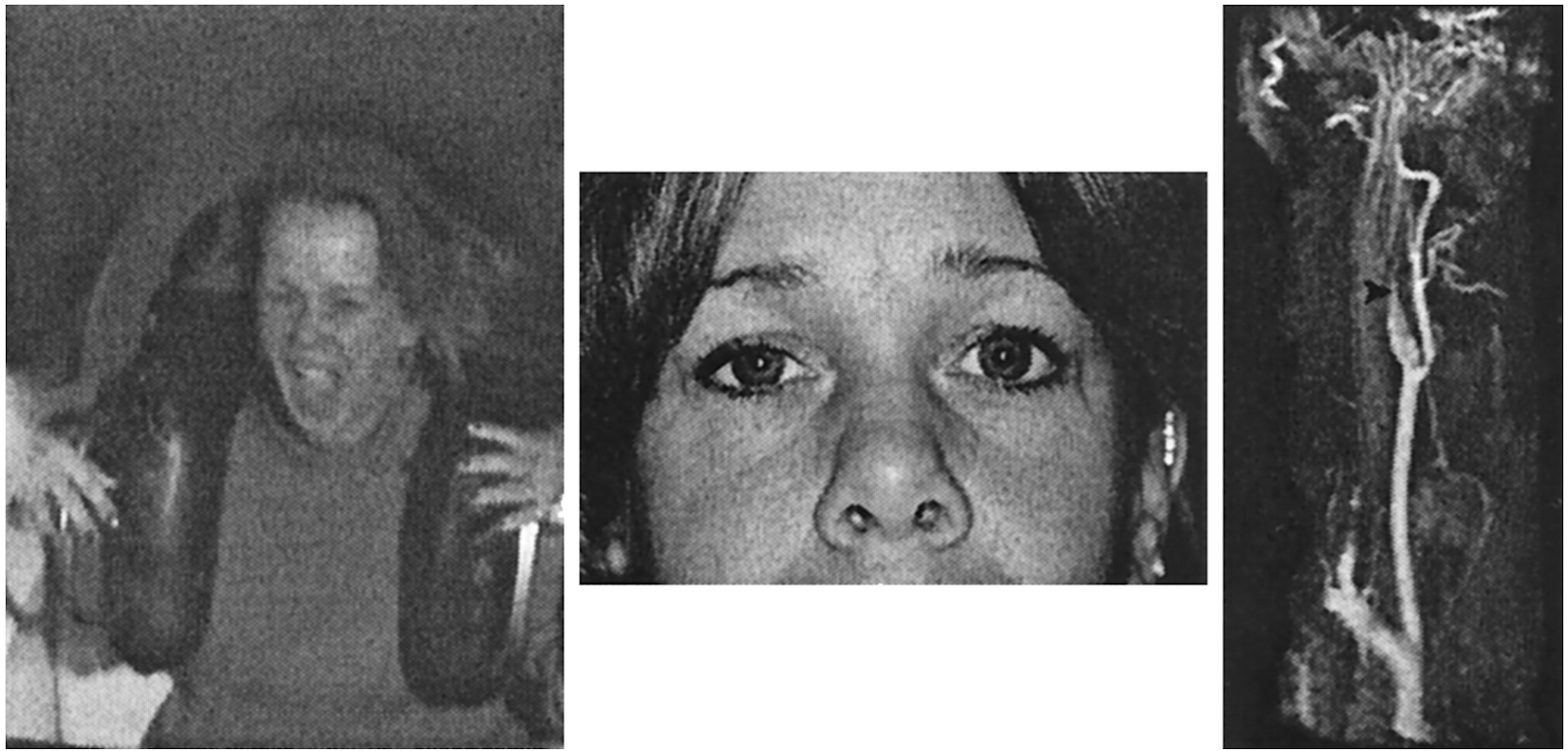
A 41-year-old woman presented with a right frontotemporal headache and drooping of the right eye. The previous day she rode a violent roller coaster ride twice (figure, left panel) and recalled vigorous jerking of her neck. Examination revealed a right Horner syndrome (figure, middle panel) with ptosis, meiosis, and no anhidrosis. Magnetic resonance angiography (figure, right panel) confirmed the diagnosis of right internal carotid artery dissection.

Figure. (A) The patient on the roller coaster ride. (B) Right Horner syndrome. (C) Magnetic resonance angiography confirmed the diagnosis of right internal carotid artery dissection.

Several other cases of carotid dissection have been reported related to amusement park equipment.

1 Roller coaster rides can generate force in excess of 4 “Gs,”1 which in combination with neck movements could potentially rip the carotid intima. Distension of the injured arterial wall compresses the adjacent sympathetic fibers,2 resulting in a Horner syndrome, which is typically without anhidrosis, in lesions above the bifurcation, where the fibers supplying the face leave to traverse with the external carotid artery.

References:
1. Braksiek R, Roberts D. Amusement park injuries and deaths. Ann Emerg Med . 2002; 39: 65–72.
2.  Mokri B, Sundt T, Houser W, Piepgras D. Spontaneous dissection of the cervical internal carotid artery. Ann Neurol . 1986; 19: 126–138.

_______________________________________

Stroke Due To Extracranial Internal Carotid Artery Dissection After Roller Coaster Rides In A 4-Year-Old Boy
Amre Npuh, Daniel Vela-Duarte, Thomas Grobelny, George Hoganson, David Pasquale, Jose Biller. 
Neurology. 2014; 82 (10 Supplement)  

Abstract
OBJECTIVE: To describe the unusual association of stroke due to an extracranial right internal carotid artery (ICA) dissection following roller-coaster rides in a 4-year old boy. BACKGROUND: Strokes in children should prompt thorough investigations. Strokes associated with roller-coaster rides are unusual.

DESIGN/METHODS: A previously healthy 4-year-old boy frequented many roller coasters with his parents while on vacation at an out of state amusement park. On the flight home the following day, his parents noticed a left facial droop. Upon landing, he was unable to walk due to left sided weakness, prompting immediate evaluation. Magnetic resonance imaging (MRI) of the brain showed an acute right middle cerebral artery (MCA) territory infarction. Magnetic resonance angiography (MRA) showed right M1CA occlusion. Catheter cerebral angiogram performed one week later demonstrated an extracranial right ICA dissection. Transthoracic echocardiogram, extensive hypercoagulable panel, serum autoimmune and inflammatory markers and cerebrospinal fluid (CSF) analysis were unremarkable. Dermatoloical evaluation showed no evidence of connective tissue disease. He received low-dose aspirin.

RESULTS: Neurological function remained stable during his hospital stay, and on a 3 month follow-up he exhibited only mild residual left spastic hemiparesis.

CONCLUSIONS: To our knowledge this is the youngest patient with stroke secondary to ICA dissection following roller-coaster rides. Although the exact mechanism of injury leading to ICA dissection in the setting of sudden linear acceleration, deceleration and rotational forces such as those experienced while riding a roller coaster is not fully understood, these injuries have been attributed to brief sustained excessive gravitational forces likely augmented among predisposed individuals. Children may be at higher risk due to the immature anatomy of their cervical spine. Alterations to roller coaster ride dynamics and use of head restraints may be a reasonable first approach to lower this potential, albeit unusual risk.

Recommended Reading – VIDEO NEUROIMAGES – Bilateral Marcus Gunn jaw-winking syndrome

Recommended Reading – VIDEO NEUROIMAGES – Bilateral Marcus Gunn jaw-winking syndrome
Deepa Kannaditharayil, Howard Geyer, Henry Hasson, Steven Herskovitz
Neurology. 2015; 84 (10)

ARTICLE
A 10-year-old boy presented with an alternating elevation of his eyelids upon chewing, present since birth (video on the Neurology® Web site at http://www.neurology.org). Examination showed mild left ptosis but no ophthalmoparesis. This represents Marcus Gunn jaw-winking syndrome (MGJWS), also called trigemino-oculomotor synkinesis or pterygoid-levator synkinesis. It likely results from aberrant connections in the midbrain between the trigeminal mesencephalic nucleus and oculomotor nucleus, although others have postulated connections between the mandibular division of trigeminal nerve innervating lateral pterygoid and the superior division of oculomotor nerve innervating levator palpebrae superioris. MGJWS occurs in 2%–13% of patients with congenital ptosis.1 It is usually unilateral but rarely presents bilaterally.2

Video https://www.youtube.com/watch?v=_m6HAys9cdQ

References:
1. Demirci H, Frueh BR, Nelson CC. Marcus Gunn jaw-winking synkinesis: clinical features and management. Ophthalmology 2010;117:1447–1452.
2. Shah AD, Kumar AB, Kothari K. Bilateral Marcus Gunn jaw-winking synkinesis with monocular elevation deficiency: a case report and literature review. Int Ophthalmol 2012;32:199–201.


Neuro-ophthalmology questions of the week: NOI17-Disorders of the Eyelid 1

Questions:
1. What are 10 causes of ptosis at birth?
2. What are the 4 categories of acquired unilateral or bilateral ptosis?
3. What are 5 types of acquired mechanical ptosis?
4. What are 4 conditions that cause acquired myogenic ptosis?
5. What are 2 causes of an acquired disorder of neuromuscular transmission?
6. What are 3 conditions that cause acquired neurogenic ptosis?
7. Is aponeurotic ptosis usually unilateral or bilateral?
8. What upper eyelid exam findings are likely to be present with aponeurotic ptosis?
9. What is the most common condition causing acquired ptosis in patients over age 50?
10. What usually causes acquired ptosis in young patients?
11. In addition to measuring eyelid positions and levator function, what 2 exam techniques should be performed in all patients with ptosis?
12. What condition must be ruled out in all patients with presumed myogenic ptosis?
13. In Horner syndrome, what is the cause of ptosis?
14. What happens to the ptosis from Horner syndrome after administration of topical apraclonidine 0.5% or 1.0%?
15. What happens to the pupils in Horner syndrome after administration of topical apraclonidine 0.5% or 1.0%? 

Neuro-ophthalmology questions of the week: NOI16-Nystagmus and Other Ocular Oscillations 4 – Other Nystagmoid Eye Movements

Questions:
24. What are the characteristics and the lesion location for convergence-retraction nystagmus?
25.  What are the characteristics, concerns, and treatment for superior oblique myokymia?
26. What are the characteristics, concerns, and the lesion location for ocular bobbing?
27. What are the characteristics of saccadic intrusions?
28. What are the characteristics and concerns for ocular flutter?
29. What are the characteristics and concerns for opsoclonus?
30. What are the characteristics and concerns for square-wave jerks and macrosquare-wave jerks?
31. What are the characteristics, concerns, and lesion location for ocular dysmetria?
32. What are the characteristics of voluntary nystagmus?
33. What are the characteristics, concerns and lesion location for internuclear ophthalmoplegia?

Recommended Reading – Treatment of Nystagmus and Saccadic Oscillations

Recommended Reading – Treatment of Nystagmus and Saccadic Oscillations

Treatment of Nystagmus and Saccadic Oscillations
Matthew J. Thurtell, and John J. Brinkley/ University of Iowa. EyeRounds.org. 2013
http://webeye.ophth.uiowa.edu/eyeforum/tutorials/Nystagmus/

Introduction
Nystagmus is often encountered in ophthalmology practice, having a prevalence of about 24 per 10,000 in the general population.[1] Unlike physiologic nystagmus, where the slow phases of nystagmus minimize retinal image slip, the slow phases of pathologic nystagmus cause retinal image slip. Retinal image slip of greater than 5 degrees per second produces a decline in visual acuity, partly because the image of the object of interest no longer lies on the fovea, and illusory motion of the visual environment known as oscillopsia.[2,3] Saccadic intrusions and oscillations can also cause visual symptoms, such as difficulty reading, since they take the eye off target so that the image of the object of interest no longer lies on the fovea.[2]

Goals of Treatment
The goal of treatment is to reduce visual symptoms (e.g., blurred vision, oscillopsia) by reducing the speed of nystagmus slow phases or by suppressing saccadic oscillations. Treatments that stop the eyes from moving altogether (e.g., botulinum toxin injections into the extraocular muscles) are not ideal, because they cause oscillopsia during head movements (due to loss of the vestibulo-ocular reflex) and diplopia (due to loss of vergence eye movements).[2] Thus, treatments that suppress the abnormal eye movements without affecting normal eye movements are preferred. Note that some types of nystagmus (e.g., gaze-evoked) and saccadic intrusions (e.g., square-wave jerks) do not usually give visual symptoms and, thus, do not require specific treatment.

General Approaches to Treatment
Treatments for nystagmus that have been proposed include medical, optical, surgical, and other miscellaneous treatments (Table 1); few of these have been evaluated in prospective masked clinical trials.[2,4] Likewise, a variety of treatments for saccadic oscillations have been proposed; few have been evaluated in prospective masked clinical trials.[2] Most treatments aim to suppress the abnormal eye movements without affecting normal eye movements, whereas others aim to negate the visual consequences of the abnormal eye movements. Choice of treatment depends on the type of nystagmus or saccadic oscillation and its characteristics. While some patients will derive benefit from one treatment approach, others require a combination of treatments.[2,4]

Full Article http://webeye.ophth.uiowa.edu/eyeforum/tutorials/Nystagmus/


Recommended Reading – Nystagmus Videos – Neuro-Ophthalmology Virtual Education Library

Recommended Reading – Nystagmus Videos – Neuro-Ophthalmology Virtual Education Library

List of related Videos from the Novel Moran Eye Center – Neuro-Ophthalmology Virtual Education Library

Novel Moran Eye Center – Neuro-Ophthalmology Virtual Education Library

https://collections.lib.utah.edu/search?facet_setname_s=ehsl_novel_jmec